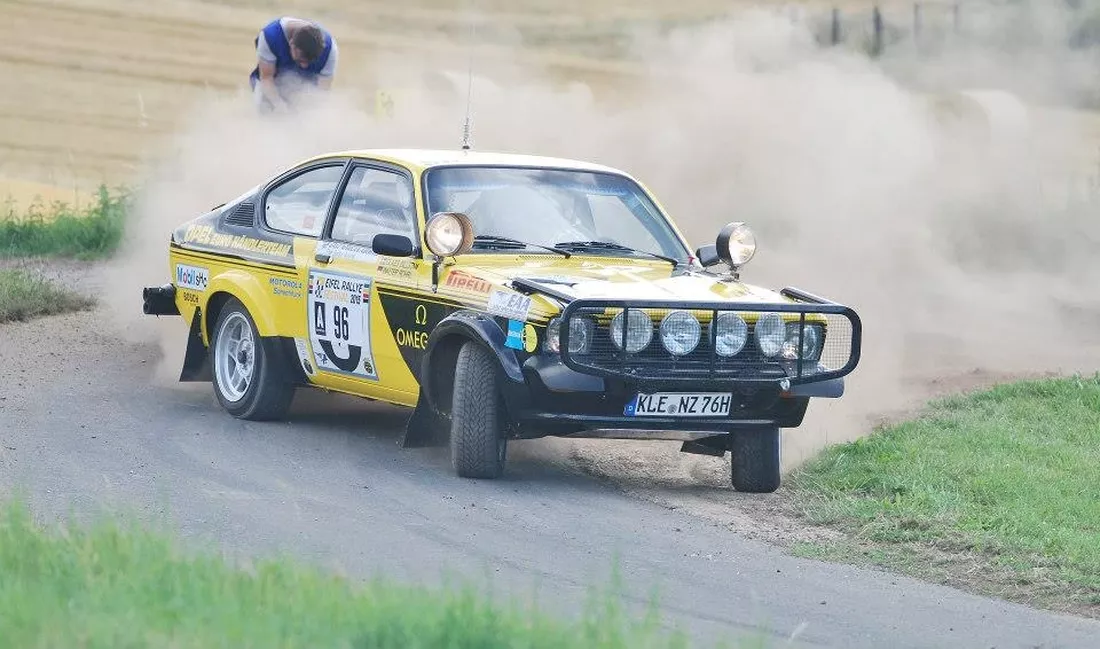
Many teams think that maintaining an average speed is infinitely more difficult. And yes, there is more speed, more adrenaline, and less margin for error. But there is a reality that often surprises: when the average speed goes up, obsessing over meters stops being so decisive.
The key becomes another: maintaining speed and helping the driver to drive better.
The great obsession with regularity: balancing meters
In regularity, the co-driver has a critical mission: to ensure that the device is perfectly calibrated and that the distance matches the roadbook.
That's why we all look for functions such as:
- Adding or subtracting meters
- Quickly balancing distances.
- Correcting trajectory deviations
- Adjusting constant references
And that's normal. For years, many rallies have been won precisely here: fine-tuning every meter.
But there's an interesting question:
Do meters penalize the same at 30 km/h as at 70 km/h?
The answer is no.
When speed increases, meters "weigh" less
Let's see it with real numbers.
|
Difference |
Speed |
Time penalty |
|
10 meters |
30 km/h |
1.2 seconds |
|
10 meters |
50 km/h |
0.7 seconds |
|
10 meters |
70 km/h |
0.5 seconds |
At low speeds, a small deviation in meters converts into many points.
In contrast, when the average speed increases, the same error has much less impact.
And there is an even more revealing piece of data:
|
Meters of error |
Speed |
Seconds |
Points |
|
1 meter |
30 km/h |
0.12 s |
0.1 |
|
2 meters |
50 km/h |
0.14 s |
0.1 |
|
2 meters |
70 km/h |
0.10 s |
0.1 |
|
3 meters |
80 km/h |
0.14 s |
0.1 |
First conclusion: Errors in meters penalize much more at low averages than at high averages.
And this completely changes the way to approach a race.
At high averages, the great enemy is losing speed
When we exceed 50 km/h, the difficulty is no longer just precision. The real challenge is maintaining the average speed.
In fast areas, everything happens much quicker:
- Braking happens earlier
- Curves require anticipation
- Trajectories are more important
- Recovering lost time is much more difficult
And here a very common problem arises: getting delayed
You enter slowly into two or three curves, lose speed, try to recover... and spend whole minutes accumulating penalties.
In regularity with relatively high or intermediate speeds, this hurts much more than being slightly offset in meters.
Second conclusion: In high average speed, it is more serious not to maintain the correct speed than to have small distance errors.
That's why many fast teams stop obsessively focusing on recalibrating every moment... and start to help the driver much more.
The co-driver can also help the car go faster
Here is where regularity transforms.
The co-driver is no longer just the one who "balances meters". They also help maintain rhythm, anticipate and drive better.
And this is achieved primarily through preparation.
Reconnaissances completely change the outcome
Teams that perform well at high averages tend to prepare recognitions with two different visions:
- The classic vision
- Balancing distances
- Verifying references
- Adjusting the roadbook
- The driving vision
- Identifying braking points
- Anticipating curves
- Detecting changes in rhythm
- Preparing useful notes for the driver
When you combine these two things, the level rises significantly.
Because the driver drives with more confidence, loses less speed, and maintains regularity better.
And here is where GPS makes the difference
Doing all this manually can be very demanding.
Announcing notes, controlling distances, balancing meters while helping the driver... is an impossible mission.
That’s why more and more teams are using GPS tools to simplify their work and focus on what really matters.
With a system like Blunik & REGO, distances are automatically recorded during the recognitions while you concentrate on:
- Making notes for each curve
- Taking strategic distance references
- Noting rhythm changes
- And anticipating the driving
And this will greatly change the experience inside the car during the rally.
Less stress. More confidence. More focus on competing.
Regularity on closed roads is not won just with precision. Strategy is needed.
There are teams that stand out for their extreme precision. Others have great driving skills.
Some have powerful and well-prepared cars. Others compensate for the lack of power with spectacular preparation.
Each team has its style, its virtues, and its strategy. In modern regularity rallies, strategy is as important as technology.
Third conclusion: In high average speeds, recognitions, notes, and anticipation can be as important as balancing meters.
The best equipment is one that allows you to focus on enjoying
At Blunik, we have been working with teams of all levels for many years.
And if there’s one thing we’ve learned, it’s this:
The best devices are not the ones that complicate regularity the most. They are the ones that allow you to concentrate on doing it better.
That’s why BLUNIK and its complement REGO are designed to equip your car from day one to the competition for the podium:
- Maximum confidence with the distance always adjusted.
- Easier to announce notes and elevate the driving level
- More help to the driver
- Less stress during the rally
- More confidence and enjoyment
Because when the average speed increases, regularity also evolves.
And perhaps the secret is no longer to obsess over every meter... but to help the driver maintain the perfect rhythm.
Do you want to discover how GPS can change your way of doing regularity?
Discover the REGO and all the possibilities of the Blunik GPS system. You will also find more tips, tutorials, and real experiences to enhance your rallies.